

If your business is still tracking customers, leads, and sales opportunities in spreadsheets, you’re not alone. For many small businesses, spreadsheets are the first tool used to organize information because they’re familiar, affordable, and easy to set up.
But as companies grow, those same spreadsheets can quickly become one of the biggest obstacles to scaling efficiently.
That’s why more organizations are replacing spreadsheets with Salesforce CRM in 2026. The shift isn’t just about adopting new technology. It’s about creating smarter processes, improving collaboration, and giving teams the visibility they need to make better decisions.
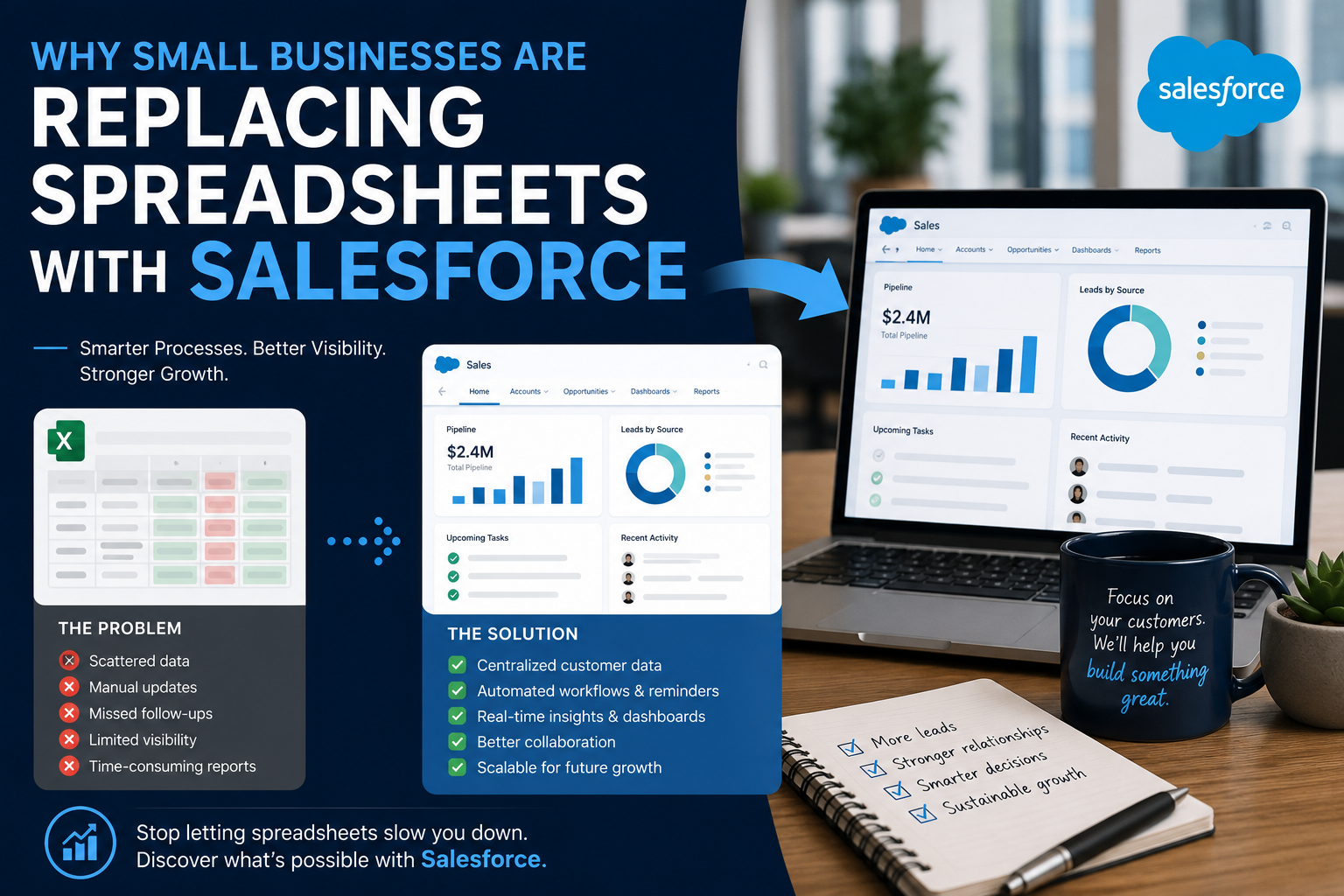
The Problem With Spreadsheets
Spreadsheets are excellent for storing information, but they weren’t designed to manage customer relationships or support growing teams.
For example, imagine a small construction company that starts with one spreadsheet to track customer inquiries. As the business expands, sales representatives begin creating their own versions to manage prospects, while managers maintain separate reports for forecasting. Before long, there are multiple versions of the truth, making it nearly impossible to know which information is current.
As businesses scale, common challenges begin to surface:
- Duplicate customer records
- Missed follow-ups
- Manual data entry
- Limited reporting capabilities
- Difficulty collaborating across teams
- Inconsistent sales processes
- Lack of accountability
Eventually, employees spend more time updating spreadsheets than serving customers or growing the business.
Signs Your Business Has Outgrown Spreadsheets
Not sure if it’s time to make the switch? Here are a few telltale signs:
- Your team maintains multiple versions of the same spreadsheet.
- Customer information is scattered across emails, notes, and files.
- Leads occasionally fall through the cracks.
- Building reports takes hours instead of minutes.
- Managers struggle to get an accurate view of the sales pipeline.
- Employees rely on manual reminders to complete follow-up tasks.
If any of these sound familiar, your business may be ready for a CRM platform that can scale alongside your growth.
Salesforce Creates a Single Source of Truth
One of the biggest advantages of Salesforce is its ability to centralize information.
Instead of customer data living across spreadsheets, inboxes, and individual desktops, Salesforce brings everything together in one secure platform.
Your team can quickly access:
- Customer history
- Open opportunities
- Notes and activity logs
- Tasks and reminders
- Service interactions
- Dashboards and reports
With everyone working from the same system, collaboration becomes easier and decisions become more informed.
Automation Reduces Manual Work
Many small businesses still spend countless hours on repetitive administrative tasks.
Consider a service-based business where employees manually send follow-up emails after every consultation request. As inquiries increase, the process becomes difficult to manage. Some prospects receive delayed responses, while others are accidentally overlooked.
Salesforce automation helps eliminate these inefficiencies by automating processes such as:
- Lead assignment
- Follow-up reminders
- Approval workflows
- Customer notifications
- Task creation
- Routine reporting
By reducing manual work, teams can focus their time on activities that create value, such as building relationships and closing deals.
Better Reporting Leads to Better Decisions
One of the biggest limitations of spreadsheets is reporting.
By the time data is gathered, cleaned, and consolidated into a presentation, it’s often outdated.
Salesforce provides real-time dashboards that help answer critical business questions, including:
- Which marketing channels generate the highest-quality leads?
- Where are opportunities getting stuck in the sales process?
- Which customers need immediate attention?
- How is the pipeline trending this quarter?
- What activities are driving revenue growth?
Instead of relying on assumptions, leadership can make data-driven decisions with confidence.
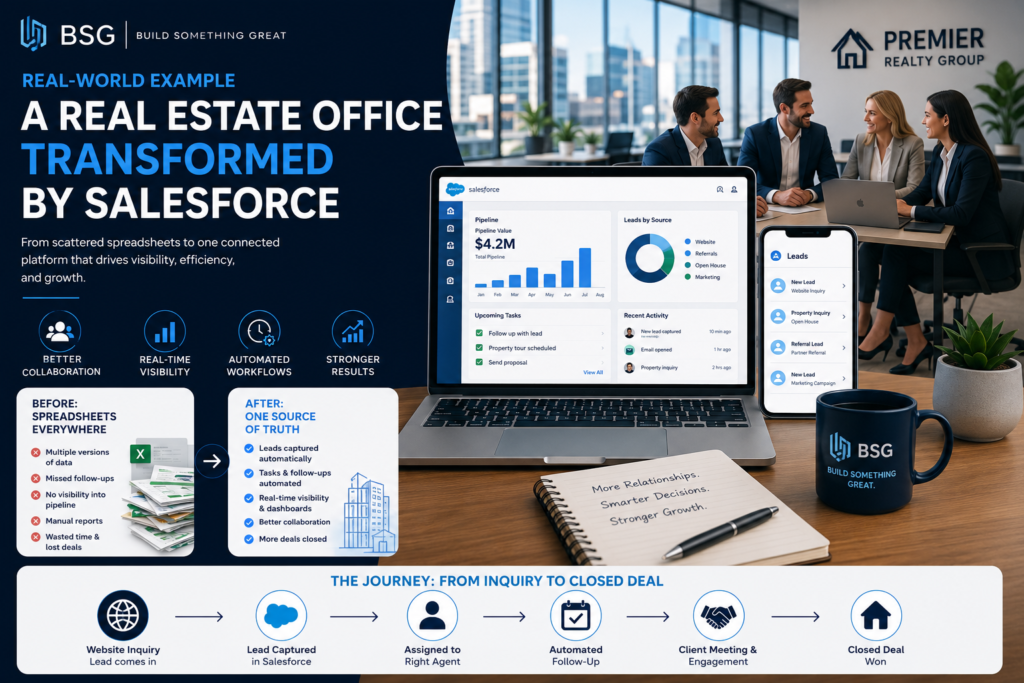
Real-World Example: Growing Beyond Manual Processes
Imagine a growing commercial real estate firm with a team of leasing agents and business development representatives. As new property inquiries come in through the company’s website, referral partners, and marketing campaigns, each agent tracks prospects in their own spreadsheet.
Before long, multiple versions of customer data exist, follow-up tasks are missed, and leadership has no clear view of the sales pipeline or leasing activity.
After implementing Salesforce, every lead, property inquiry, and client interaction is captured in one centralized platform. Automated workflows assign new inquiries to the appropriate agent, reminders ensure timely follow-up, and real-time dashboards give leadership visibility into occupancy trends, deal progression, and team performance.
Instead of spending hours reconciling spreadsheets, employees can focus on building relationships with clients and closing new business. The technology doesn’t just organize information. It enables the entire organization to operate more efficiently and scale with confidence.
Scalability Matters
What works for a five-person business rarely works for a fifty-person business.
As organizations grow, they need systems that can evolve with them.
Salesforce provides the flexibility to support expanding teams, additional service offerings, multiple sales pipelines, marketing initiatives, and customer support operations without requiring businesses to rebuild their processes from scratch.
That scalability becomes a significant competitive advantage over time.
It’s Not Just About Technology
Many people assume implementing a CRM is simply a software decision.
In reality, it’s a business strategy decision.
The companies that get the most value from Salesforce aren’t just purchasing a platform. They’re investing in better communication, standardized processes, stronger customer relationships, and improved operational visibility.
Technology becomes the foundation that enables long-term growth.
Key Benefits of Replacing Spreadsheets With Salesforce
Making the transition to Salesforce can help small businesses:
- Centralize customer data
- Automate repetitive tasks
- Improve team collaboration
- Increase visibility into the sales pipeline
- Generate real-time reports and dashboards
- Reduce manual errors
- Create scalable processes for future growth
Final Thoughts
Spreadsheets have served small businesses well for decades, but they often struggle to keep pace with growing organizations and increasing customer expectations.
The goal isn’t simply to replace spreadsheets. It’s to create a smarter, more connected way of working that empowers your team and delivers a better experience for your customers.
The businesses thriving today aren’t necessarily the largest. They’re the ones investing in systems that support better decisions, stronger relationships, and sustainable growth.
At BSG Tech Solutions, we believe technology should simplify operations and empower organizations to reach their full potential. When the right strategy meets the right solution, you don’t just modernize your business – you build something great.
