

Every growing business reaches a turning point.
Sales teams begin juggling hundreds of opportunities. Customer information lives in spreadsheets, inboxes, and individual notebooks. Leadership asks for a simple pipeline report, only to discover it takes days to compile because every department tracks information differently.
Eventually, someone asks the question:
“Is it time for Salesforce?”
For many organizations, the answer is yes. Salesforce has become the world’s leading customer relationship management (CRM) platform for a reason. It helps businesses centralize customer data, automate repetitive work, improve collaboration, and make more informed decisions.
But here’s what often gets overlooked.
Implementing Salesforce doesn’t automatically solve business problems. It simply gives organizations the tools to solve them more effectively.
The companies that see the greatest return on their Salesforce investment don’t start by asking which features they need or how quickly they can go live. They start by taking a step back and evaluating their business.
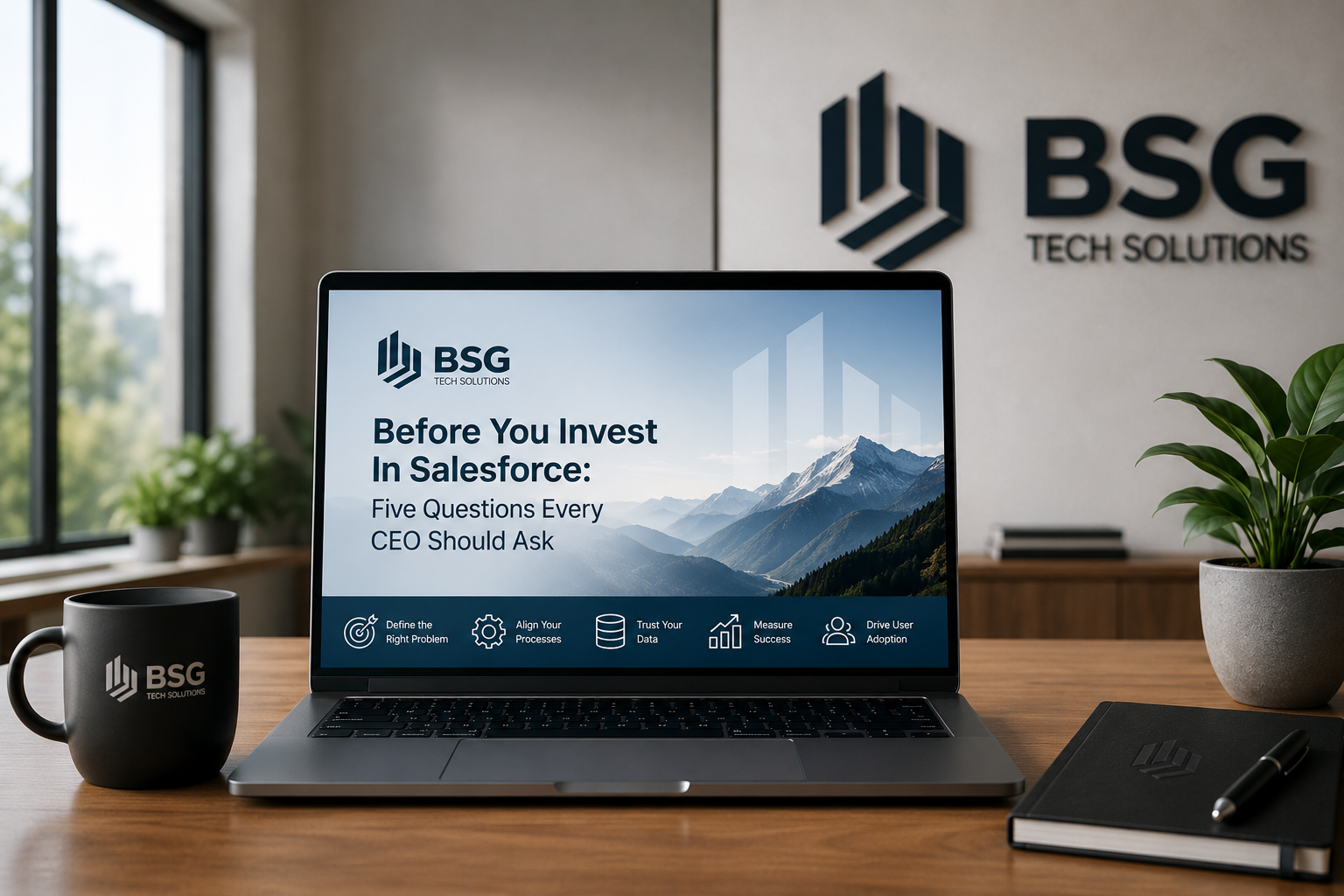
If you’re considering Salesforce, these are the five questions every CEO should ask before making the investment.
1. Are We Solving the Right Problem?
Technology should never be the starting point.
The first conversation should always revolve around the business challenge you’re trying to solve.
Many executives assume they have a sales problem when, in reality, they have a process problem. Others believe they need more leads, when the real issue is inconsistent follow-up or limited visibility into existing opportunities.
A commercial real estate brokerage experienced this firsthand. Leadership believed they needed better lead generation because new business had slowed. However, after evaluating their operations, they discovered they were already receiving a healthy number of qualified inquiries each month.
The challenge wasn’t attracting prospects. It was managing them.
Each broker maintained separate spreadsheets, client notes were scattered across personal inboxes, and follow-up depended largely on individual habits. Leadership had no reliable way to see where opportunities stood or which clients needed attention.
By identifying the real problem before implementing Salesforce, the brokerage was able to build a solution around standardized lead management instead of simply adding another piece of software.
That’s an important distinction.
Technology amplifies good processes, but it also exposes weak ones.
Before investing in any CRM, ask yourself:
What business challenge are we truly trying to solve?
The clearer your answer, the greater the return on your investment.
2. Are Our Processes Ready to Scale?
Growth has a way of exposing operational gaps.
The informal processes that worked when your company had ten employees often begin to break down when you have fifty, one hundred, or even several hundred.
Sales may qualify leads differently than marketing.
Customer service may document information differently than account management.
Operations may maintain its own reporting because it doesn’t trust the data from other departments.
When every team creates its own version of the truth, technology alone cannot fix the problem.
Successful Salesforce implementations begin with clearly defined business processes.
- How does a lead become an opportunity?
- When does a customer transition from sales to implementation?
- Who owns each stage of the customer journey?
- What information needs to be captured along the way?
These conversations aren’t always easy, but they’re essential.
A professional services firm preparing to implement Salesforce discovered that each department had a different definition of a “qualified customer.” Marketing celebrated leads that sales considered unqualified, while project managers often received incomplete customer information after contracts were signed.
Before automating a single workflow, leadership brought representatives from every department together to map the customer journey from beginning to end. Once everyone agreed on a standardized process, Salesforce became the platform that reinforced consistency across the organization.
Technology works best when everyone agrees on how the business should operate before automation begins.
3. Can We Trust Our Data?
Imagine building your dream home on an unstable foundation.
No matter how beautiful the finished product may be, cracks will eventually appear.
The same principle applies to CRM implementations.
Salesforce can organize, automate, and analyze information, but it cannot determine whether the information itself is accurate.
Duplicate customer records, outdated contact information, inconsistent naming conventions, and incomplete data have a way of following organizations into their new CRM if they aren’t addressed beforehand.
Unfortunately, many companies underestimate just how much poor data affects daily operations.
Reports become unreliable.
Automation triggers incorrectly.
Employees lose confidence in the system.
Leadership begins questioning whether Salesforce is providing value when, in reality, the issue has nothing to do with the platform itself.
One regional property management company discovered this while preparing for implementation. During data migration, they uncovered multiple versions of the same property, duplicate tenant records, outdated ownership information, and years of inconsistent data entry practices.
Cleaning the data required additional time upfront, but it paid dividends after launch. Employees trusted the information they were seeing, dashboards reflected accurate business performance, and leadership could make decisions with confidence.
Clean data isn’t simply an IT initiative. It’s a business advantage.
4. How Will We Measure Success?
Many organizations spend months planning an implementation but surprisingly little time defining what success actually looks like.
Once Salesforce goes live, excitement naturally centers around the launch itself. But implementation isn’t the finish line. It’s the starting point.
Before investing in Salesforce, establish measurable business outcomes that align with your organization’s goals.
Perhaps success means reducing lead response times from two days to two hours.
Maybe it’s improving forecast accuracy, increasing sales conversion rates, or eliminating manual reporting that currently consumes valuable employee time.
Whatever the objective, it should be clearly defined before implementation begins.
Without measurable goals, it’s difficult to determine whether the investment is delivering meaningful business value.
More importantly, success metrics provide employees with a shared understanding of why the organization is making the investment in the first place.
People are far more likely to embrace change when they understand the purpose behind it.
5. Who Will Lead the Change?
One of the biggest misconceptions about CRM implementation is that it’s primarily a technology project.
It isn’t.
It’s a people project.
Salesforce can transform the way an organization operates, but only if employees adopt it.
That requires leadership.
Executive sponsorship is one of the strongest predictors of implementation success. When leadership actively supports the initiative, communicates its value, and reinforces new ways of working, adoption becomes much easier.
At the same time, organizations benefit from identifying internal champions across departments. These individuals become advocates for the platform, answer questions, collect feedback, and help colleagues navigate change.
Without that support, even the most sophisticated CRM can become another system employees reluctantly update while continuing to rely on spreadsheets and personal notes.
Successful implementations don’t happen because software was installed.
They happen because people believe in the process.
Technology Doesn’t Transform Businesses. People Do.
Salesforce is one of the most powerful business platforms available today, but its greatest value isn’t found in dashboards, automation, or artificial intelligence.
Its value comes from helping people work together more effectively.
Organizations that take the time to define their objectives, standardize their processes, improve their data quality, establish meaningful success metrics, and invest in change management consistently outperform those that view Salesforce as a quick technology fix.
In many ways, Salesforce simply reflects the health of your business.
Strong processes become stronger.
Clear communication becomes clearer.
Reliable data becomes more valuable.
The platform doesn’t create those things on its own—it enables them.
Final Thoughts
Investing in Salesforce is more than a technology decision. It’s a strategic investment in the future of your business.
The organizations that realize the greatest return aren’t necessarily the ones with the most complex implementations or the largest budgets. They’re the ones that begin with thoughtful planning, honest conversations, and a clear understanding of what success looks like.
Before evaluating features, comparing licenses, or discussing implementation timelines, take the time to ask the right questions. Doing so will help ensure Salesforce becomes more than just another business application—it becomes a platform that supports sustainable growth, stronger customer relationships, and smarter decision-making.
At BSG, we believe every successful Salesforce journey begins with understanding the business first. Technology should empower your people, strengthen your processes, and support your long-term vision.
Because when strategy comes before software, you’re not just implementing Salesforce. You’re creating the foundation to Build Something Great.
