

Introduction
You invested in a CRM to grow your real estate business. But what if the tool you bought to solve your problems is quietly making them worse — because it’s being used the wrong way?
Across real estate companies — from boutique brokerages to large developers — the same patterns appear again and again. Leads go cold. Agents skip the CRM. Management can’t tell which deals are real and which are wishful thinking. The problem is rarely the software itself. It’s how the organisation uses it.
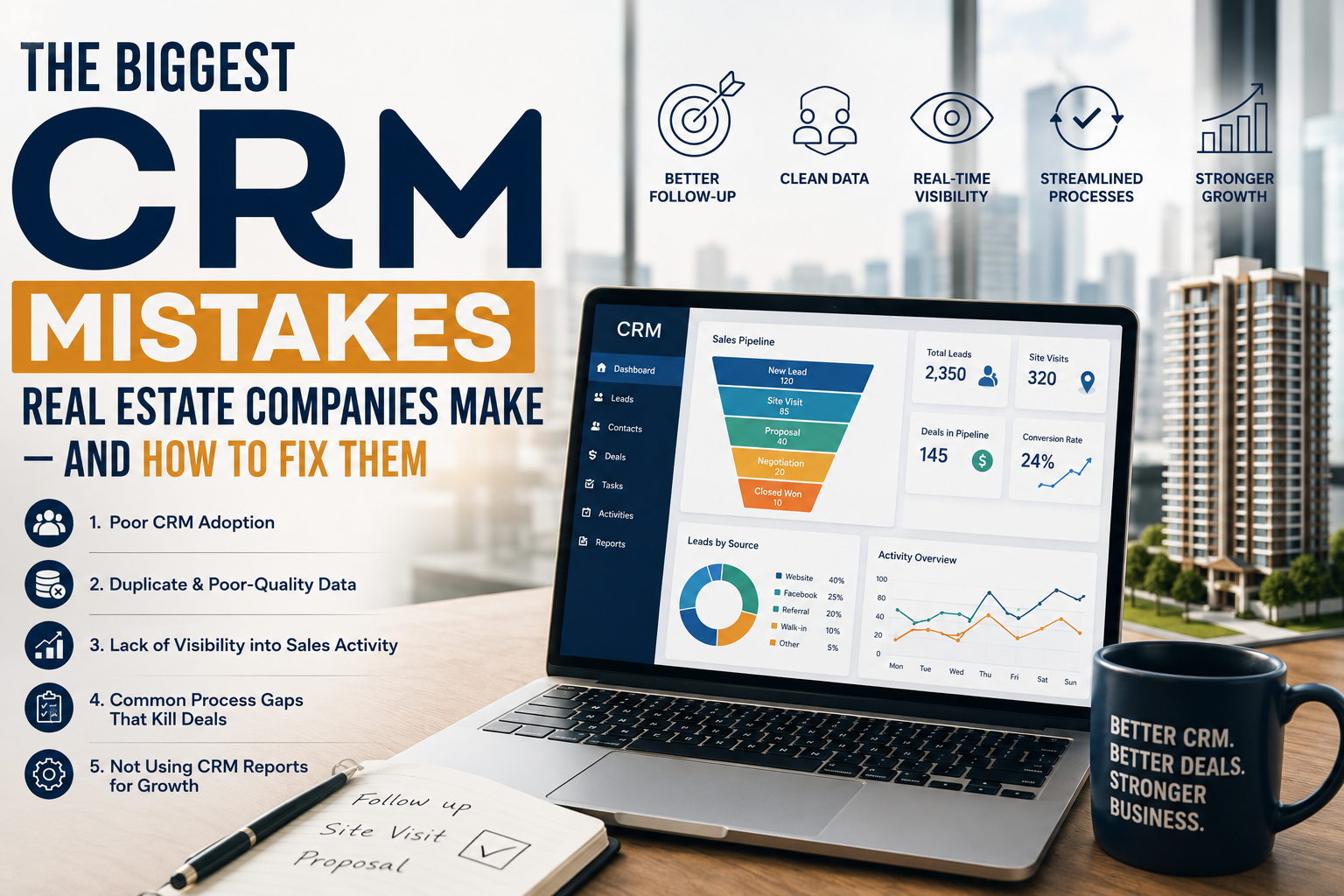
Here are the five biggest CRM mistakes real estate companies make — and, more importantly, how to fix them before they stall your growth.
Mistake 1: Poor CRM Adoption by Agents and Sales Teams
Why teams avoid using CRM
Ask any sales manager in real estate, and they’ll tell you the same thing: “Our agents don’t update the CRM.” The reasons are predictable. Agents see it as an administrative burden, not a sales tool. The interface has too many mandatory fields. There was a one-day training six months ago and nothing since. And when leadership themselves track deals in a spreadsheet, the message is clear — the CRM is optional.
The impact
When agents bypass the CRM, follow-up gaps appear silently. A site visit happens but no one logs it. A hot lead goes cold while the agent moves on to another project. Management makes decisions based on verbal updates rather than data. Customer experience suffers because no one has context on where a buyer stands.
How to fix it
Start by simplifying. Reduce mandatory fields to the essentials: name, phone number, lead source, current status, and next action. Run monthly refresher sessions, not just onboarding. Most critically, leadership must use the CRM visibly — when managers log their own activity, teams follow. Tie CRM usage to commission reviews to make adoption a professional expectation, not a suggestion.
Mistake 2: Duplicate and Poor-Quality Data
The problem with bad data
Multiple lead sources — Facebook, property portals, walk-ins, broker referrals — feed into the CRM without any deduplication rules. Agents create new records instead of searching for existing ones. A single buyer can appear as four separate leads in the system. No one owns data quality, so it becomes everyone’s problem and no one’s responsibility.
How bad data damages your business
Marketing sends duplicate campaigns to the same prospect. Sales reports show an inflated pipeline that doesn’t reflect reality. Leadership makes hiring and inventory decisions based on numbers that simply aren’t accurate. In high-value real estate transactions, decisions made on bad data have a direct financial cost.
How to fix it
Set up automatic deduplication rules on mobile number and email address the moment a lead enters the system. Establish a monthly data audit process and assign a designated data owner per team. Enforce field validation at the point of entry — if a phone number or project interest isn’t captured upfront, the record is incomplete. A clean CRM with 2,000 accurate leads will consistently outperform a bloated one with 10,000 duplicates.
Mistake 3: Lack of Visibility into Sales Activity
No clear picture of what’s happening
When deal stages are vague — “in discussion” can mean anything from an initial call to a near-signed agreement — management has no real view of pipeline health. Activity tracking isn’t configured. Managers rely on WhatsApp messages and verbal standups instead of live dashboard data. They find out a deal has stalled only when it’s already lost.
The impact on forecasting and decisions
Without visibility, sales leaders can’t forecast with confidence, can’t identify which agents need coaching, and can’t spot which projects are underperforming until it’s too late. This is a particularly serious risk in real estate, where inventory planning and team resourcing depend on accurate projections.
How to fix it
Build a real-time activity dashboard that tracks calls made, site visits completed, follow-up tasks pending, and days spent in each pipeline stage. Set automated alerts when a lead sits in one stage beyond a defined threshold — say, more than five days without activity. Define stage criteria precisely and consistently. “Site Visit Completed” should mean a confirmed, logged visit — not a verbal mention that it might happen.
Mistake 4: Common Process Gaps That Kill Deals
This is the most widespread issue for small real estate teams — and the one with the most fixable causes.
The patterns that appear in almost every team:
- Leads sit unassigned for hours while agents wait for instructions, and the prospect has already moved on
- Follow-up reminders don’t get set, or get snoozed indefinitely and never resurface
- Marketing passes leads to sales with no context about source, campaign, or interest level
- Operations only hears about a deal at the point of closing, creating last-minute paperwork chaos
- The actual pipeline lives in someone’s personal Excel file or a WhatsApp group thread
How to fix it
Automate lead assignment the moment a lead enters Salesforce — route by project, geography, or lead source with no manual intervention required. Build follow-up task sequences that trigger automatically after each stage change, so agents are prompted rather than expected to remember. Create a clear handoff protocol between marketing and sales: campaign data, lead source, and any prior interactions must be logged before a lead is assigned. Any deal tracked outside Salesforce — whether in Excel, Notes, or WhatsApp — should be migrated immediately. Structure replaces memory, and memory always fails eventually.
Mistake 5: Using CRM as a Database, Not a Growth Engine
The missed opportunity most teams don’t see
The majority of real estate teams use their CRM for one thing: storing contact details and updating deal status. That’s valuable, but it captures perhaps 20% of what a well-configured Salesforce instance can actually do for your business.
Here’s what teams are leaving on the table:
- Lead nurturing: Automate drip sequences for leads who aren’t ready to buy yet. A prospect who visits a project today might convert in six months — if you stayed in touch with relevant, timely content.
- Customer segmentation: Group leads by budget range, preferred unit type, location, or buying timeline. Segment your outreach accordingly and watch response rates improve.
- Campaign tracking: Connect every lead back to its source — Facebook ad, property portal, broker referral, walk-in. Understand which channels deliver quality buyers, not just volume.
- Sales forecasting: A structured, well-maintained pipeline history allows you to project monthly closures with confidence. This makes resourcing and inventory decisions far more reliable.
- Post-sale engagement: The relationship doesn’t end at registration. Buyers who feel looked after become referral sources. CRM-triggered check-in messages, annual property value updates, and upgrade offers are all achievable — and almost entirely unused in real estate today.
How to fix it
Audit your Salesforce setup against these five capabilities. If any are absent or misconfigured, schedule a dedicated setup sprint — not a future agenda item, a fixed date. The real estate teams that treat their CRM as a growth engine consistently outsell those that treat it as a filing cabinet.
Fix the Foundation Before You Scale
Every mistake covered above is fixable. None of them require buying new software or hiring more people. They require intent — a decision to treat the CRM as a strategic tool rather than a compliance checkbox.
The real estate companies that scale effectively over the next few years won’t just have bigger teams or more leads. They’ll have better systems. They’ll know exactly where every lead stands, which channels are working, and what their pipeline will close next month.
Before you hire the next salesperson, launch the next campaign, or expand to a new project — audit your CRM setup. Fix the foundation. Then scale.
Your next step: Walk through your Salesforce instance this week with your team lead. Check five things: lead assignment rules, follow-up task automation, pipeline stage definitions, data quality, and dashboard visibility. If any of them are broken or missing, that’s where you start.
Written for real estate business owners, sales leaders, brokers, and operations teams building scalable sales processes.
